

Designing for rhythm in a world optimized for speed
A product design case study exploring sustainable focus, pacing, and human-centered planning.
Project Overview
Project: Routinely Mobile Ap
Role: Founder / Product Designer
Timeline: Ongoing (Early-stage)
Platform: Mobile (iOS / Android)
Scope: Product strategy, systems design, UX direction
Routinely is an early-stage product design project exploring how planning tools can support sustainable focus rather than constant output.
The project began as a response to a recurring pattern I observed in myself and others: motivation wasn’t the problem — pacing was. Existing tools optimized for speed, urgency, and streaks often created pressure rather than clarity.
Routinely reframes planning as a rhythm — balancing focus, rest, reflection, and connection — and treats time as a human experience, not a machine to optimize.
Problem Framing
Modern productivity tools tend to reward consistency through pressure — streaks, reminders, and performance metrics that assume more structure always leads to better outcomes.
Through observation and early conversations, I noticed that many people didn’t struggle to start tasks. They struggled to maintain a healthy pace over time.
The issue wasn’t time management — it was energy misalignment.
When planning tools ignore fluctuations in energy, attention, and context, they unintentionally encourage burnout rather than consistency.

Constraints and Assumptions
Routinely was designed under intentional constraints:
Solo designer and early-stage founder
No predefined user base
Limited engineering bandwidth
High ambiguity around behavior change
Rather than attempting to solve everything at once, the focus was on establishing a clear design philosophy and a flexible system that could evolve over time.
**Note: Several features and mechanics are intentionally omitted or abstracted in this case study, as the product is still in active development.
Process overview
The process prioritized clarity over completeness. Instead of starting with features, I began by mapping emotional and behavioral patterns around planning, then gradually translated those insights into structure.
Process stages:
Problem framing & pattern recognition
Conceptual exploration (mental models, metaphors)
Structural definition (information hierarchy, core loops)
Iteration through reflection and early feedback
The goal was not to design a perfect system, but to create one that could adapt to real human rhythms.
Systems Thinking & Information Architecture
Rather than designing isolated screens, Routinely was approached as an interconnected system. The product is organized around four recurring forces that shape how people plan their time:
Framework:
Now — presence and immediate focus
Later — pacing, foresight, and rhythm
Connect — shared time and connection
Myself — reflection and identity
This framework guided navigation, language, and feature prioritization, ensuring the system could support both structure and flexibility.
Selected Design Artifacts
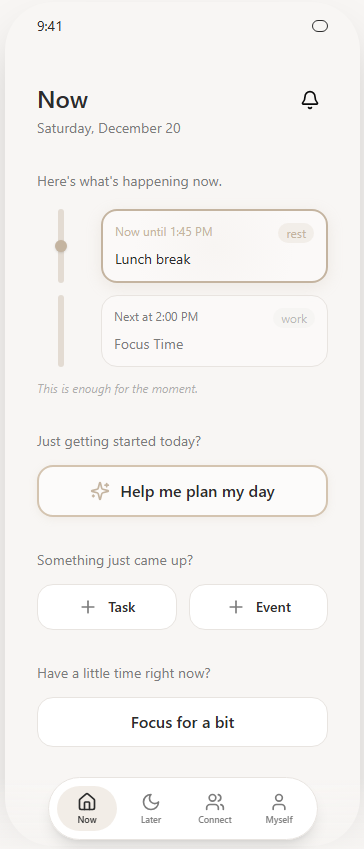
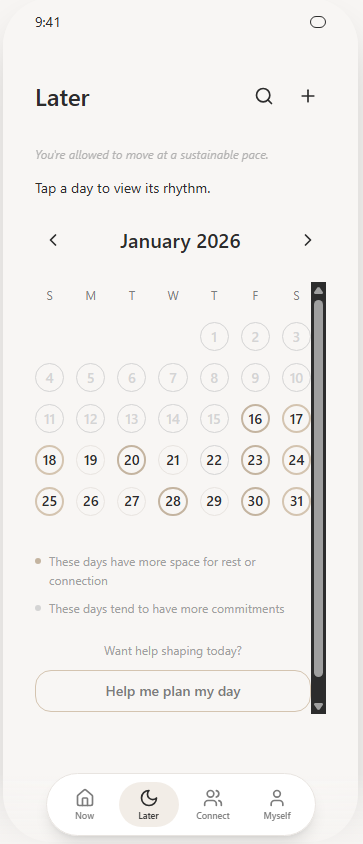
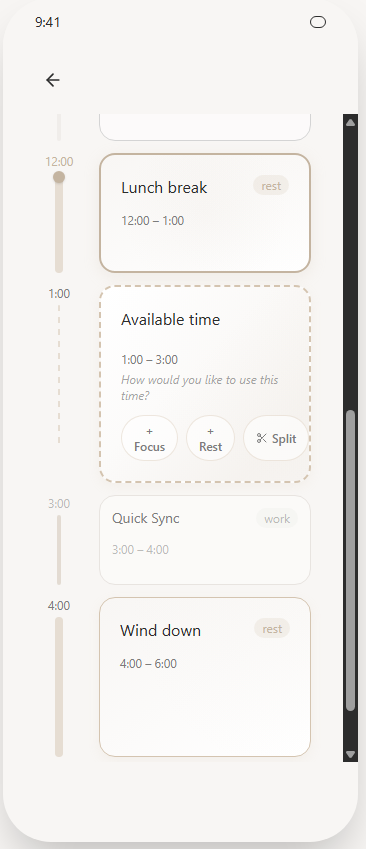
The following screens represent three core moments in the Routinely experience: present awareness, future pacing, and intentional use of available time. Rather than optimizing for density or speed, these views were designed to reinforce calm decision-making, flexible structure, and a sense of permission.
The “Now” view prioritizes situational clarity over task accumulation. Instead of presenting a full day’s workload, the interface surfaces only what is immediately relevant, reinforcing the idea that this is enough for the moment. Language and spacing were intentionally softened to reduce urgency and cognitive load.
The “Later” view reframes calendar planning as rhythm rather than obligation. Visual density is reduced, and subtle cues communicate which days naturally allow for rest or connection. This shifts planning from filling time to recognizing capacity.
When open time appears, the interface offers guidance without prescription. Rather than auto-filling available space, the system invites the user to choose how they want to use their time — focus, rest, or division — reinforcing agency over automation.
Learning & Iteration
Designing Routinely challenged several early assumptions:
Simplicity required more structure, not less
Language choices had a larger emotional impact than expected
Removing features often improved clarity more than adding them
These insights directly influenced hierarchy, copy, and interaction density across the product.

What’s Next
Routinely is moving toward a small private launch.
Near-term focus includes:
Refining reflection loops
Testing pacing over longer time horizons
Observing how users respond to gentler accountability
The project remains intentionally open-ended, allowing real-world use to guide future iterations.